
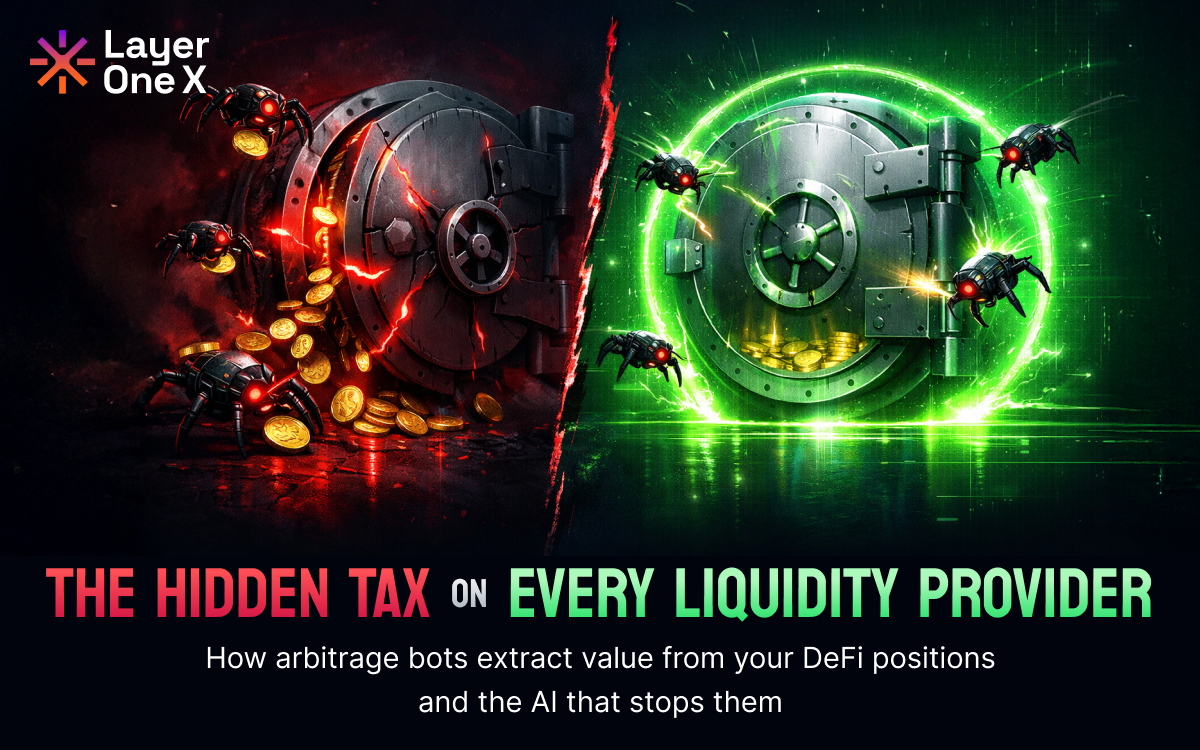
How arbitrage bots silently drain your liquidity pool and how L1X's Neural Liquidity Orchestrator AI is learning to shut them out
The Promise vs The Reality
DeFi liquidity pools promise a simple deal: deposit your tokens, earn fees from every trade. Put your money to work. And yes, you do earn fees. But there is a hidden leak that most people never see, and it is draining value from your position every single day.
That leak has an academic name: Loss-Versus-Rebalancing (LVR). In plain English, it means arbitrage bots are extracting money from your liquidity position every time the market moves.
How a Liquidity Pool Actually Works
A liquidity pool has no price feed. It does not check Binance. It does not read CoinGecko. It does not consult an oracle. It only knows two numbers: how much of Token A is in the pool and how much of Token B is in the pool.
The price is simply the ratio between those two amounts. If a pool holds 10 WBNB and 5,000 USDT, the implied price is 5,000 / 10 = $500 per WBNB.
This price only changes when someone makes a trade. The pool is completely blind to the outside world. The pool price and the exchange price are two entirely separate things. They only stay roughly in sync because arbitrage bots constantly trade to close any gap.
And that is exactly where the problem begins.
The Attack: How Bots Extract Your Value
Every time the real market price moves faster than your pool gets traded, a gap opens between the pool price and the real price. Bots see this gap and exploit it. Every time they close it, value flows from your pool into their wallets. This happens in both directions. Any fast price movement, up or down, creates the same vulnerability.
Scenario 1: WBNB Crashes ($500 to $450)
You have $100 in a WBNB/USDT pool. That is 0.1 WBNB ($50) and 50 USDT ($50). Then WBNB crashes from $500 to $450 on Binance.
|
Step |
Event |
What the Bot
Does |
Pool
Receives |
Pool Gives
Out |
Who Wins |
|
1 |
Everything
calm |
Nothing |
-- |
-- |
Nobody |
|
2 |
Binance price
drops to $450. Pool still priced at $500 |
Bot buys WBNB
on Binance for $450 |
-- |
-- |
Gap opens |
|
3 |
Bot sells
that WBNB into your pool at the pool's $500 rate |
Sells WBNB to
pool |
Pool gets
WBNB |
Pool gives
out USDT worth ~$500 |
Bot profits
~$50 |
|
4 |
Pool now has
more WBNB, less USDT |
-- |
-- |
-- |
Pool lost
value |
|
5 |
Bots repeat
until pool price matches $450 |
More of the
same |
More WBNB
piling up |
More USDT
leaving |
Bots keep
extracting |
|
End |
Pool is
heavy on WBNB (crashed asset) and drained of USDT |
|
|
|
You lost.
Bots won. |
The pool thought WBNB was still valuable at $500. So when the bot offered WBNB, the pool accepted it and paid good USDT for it. The pool overpaid for a falling asset using your stable dollars because it did not know the price had already moved.
Scenario 2: WBNB Pumps ($500 to $550)
Same pool, same $100 position. But this time WBNB pumps from $500 to $550 on Binance.
|
Step |
Event |
What the Bot
Does |
Pool
Receives |
Pool Gives
Out |
Who Wins |
|
1 |
Everything
calm |
Nothing |
-- |
-- |
Nobody |
|
2 |
Binance price
pumps to $550. Pool still priced at $500 |
Bot spots
cheap WBNB in your pool |
-- |
-- |
Gap opens |
|
3 |
Bot buys WBNB
from your pool at the pool's $500 rate using USDT |
Buys WBNB
from pool |
Pool gets
USDT worth ~$500 |
Pool gives
out WBNB worth $550 on Binance |
Bot profits
~$50 |
|
4 |
Bot sells
that WBNB on Binance at $550 |
Cashes out |
-- |
-- |
Bot pockets
$50 |
|
5 |
Bots repeat
until pool price matches $550 |
More of the
same |
More USDT
coming in |
More WBNB
leaving |
Bots keep
extracting |
|
End |
Pool is
heavy on USDT and drained of WBNB (the asset that pumped) |
|
|
|
You lost.
Bots won. |
You now hold less WBNB (the asset that went up) and more USDT. You missed the upside. The bots bought your underpriced WBNB and sold it at the real price elsewhere.
The Pattern: It Works in Both Directions
|
|
Crash |
Pump |
|
Bots sell
to your pool |
Overpriced
WBNB |
Underpriced
USDT |
|
Bots buy
from your pool |
Underpriced
USDT |
Underpriced
WBNB |
|
You end up
holding more of |
The loser
(crashed WBNB) |
The loser
(USDT that didn't pump) |
|
Value
leaked to |
Bots |
Bots |
|
The cause |
Pool price
was stale |
Pool price
was stale |
The common thread is speed, not direction. Any time the real market price moves faster than the pool gets traded, a gap opens. Bots close that gap. Every time they do, value flows from your pool to their wallets.
Understanding the Extra Loss
A common question: if WBNB drops, you lose money either way, so what is the AI actually protecting?
The answer: the AI does not protect you from market drops. It protects you from the extra loss that the pool mechanics cause on top of the market drop.
$100 Example: Wallet vs Pool
Start: $100 in WBNB/USDT pool = 0.1 WBNB ($50) + 50 USDT ($50). WBNB crashes from $500 to $450.
|
|
WBNB Held |
USDT Held |
Total |
|
Wallet (AI
pulled out) |
0.1 WBNB =
$45 |
50 USDT = $50 |
$95 |
|
Pool
(passive staker) |
0.111 WBNB =
$50 |
40 USDT = $40 |
$90 |
Both lost money. But the passive staker lost $10 while the AI user lost $5. The $5 difference exists because the pool gave 10 of your USDT to arbitrage bots in exchange for WBNB that was already losing value. The pool overpaid for a falling asset using your stable dollars because it did not know the price had already moved.
That $5 gap is the extra loss. It is not a market loss. The market did not take it from you. A bot did, using your own pool against you.
The Neural Liquidity Orchestrator: Three Phases
The NLO does not predict the future. It does not need to. It monitors volatility and makes one simple decision: should your money be in the pool right now, or not?
Phase 1: Defensive Alpha (Avoid the Damage)
The AI detects volatility spiking. It pulls your liquidity out of the pool before the worst of the move. Your tokens sit in your wallet. No pool formula. No forced rebalancing. No bots trading against your stale price. Your USDT stays as USDT.
Phase 2: Arbitrage Defense (Close the Shop)
With your liquidity removed, there is nothing for arbitrage bots to trade against. They cannot buy your underpriced tokens because your tokens are not in the pool. Your shop is closed. Your inventory is safe.
Phase 3: Re-Entry (Compound the Win)
When volatility drops and conditions stabilize, the AI re-stakes your tokens back into the pool. Because you preserved your capital during the crash, you re-enter with more purchasing power than passive stakers who rode through the damage. You earn fees on a stronger base. This compounds over time.
Full Running Example: 10 Days, $100 Start
|
Day |
WBNB Price |
Market Event |
AI Action |
AI Value |
Passive
Value |
Gap |
|
1 |
$500 |
Calm |
IN pool |
$100.30 |
$100.30 |
$0.00 |
|
2 |
$450 |
Crash |
PULLED OUT |
$95.30 |
$89.55 |
+$5.75 |
|
3 |
$450 |
Stable |
RE-ENTER |
$95.59 |
$89.82 |
+$5.77 |
|
4-9 |
$450-460 |
Calm, small
moves |
IN pool |
$97.40 |
$91.50 |
+$5.90 |
|
10 |
$420 |
Second dip |
PULLED OUT |
$89.00 |
$78.00 |
+$11.00 |
After just 10 days and two volatile events, the AI user has $11 more than the passive staker on a $100 position. The AI earned slightly less in fees (it missed some days), but saved far more by avoiding the damage during crashes.
The Bigger Vision
Everything above describes the NLO protecting your position pool. But the same AI that predicts volatility to decide when to exit can also scan thousands of pools across multiple chains and decide where to enter.
At any given moment, some pools are calm with high APY. Others are volatile death traps. The NLO evaluates risk versus reward across all of them and moves your capital to the best opportunity automatically.
This means you don't just get protection. You get optimized yield. The AI picks the safest, highest earning pool for current conditions, earns fees, detects danger, exits, and then finds the next best opportunity. All autonomously. All on your behalf.
This is where the NLO is heading. One deposit. Thousands of pools. AI managed.
Summary
The AI generates alpha in two ways:
1. Defensive Alpha: By not being in the pool during crashes, your stable assets are protected from forced rebalancing. Bots cannot trade against liquidity that is not there.
2. Offensive Yield: By only exposing funds to the pool when fee revenue exceeds the risk of loss, the AI ensures your capital works for you only when conditions are favorable.
It is the financial equivalent of taking your chips off the table when the odds turn bad, and putting them back when the odds are in your favor.
Impermanent loss is not mysterious. It is a pricing delay problem. The future of DeFi is not just providing liquidity. It is protecting it.
This is the Neural Liquidity Orchestrator.